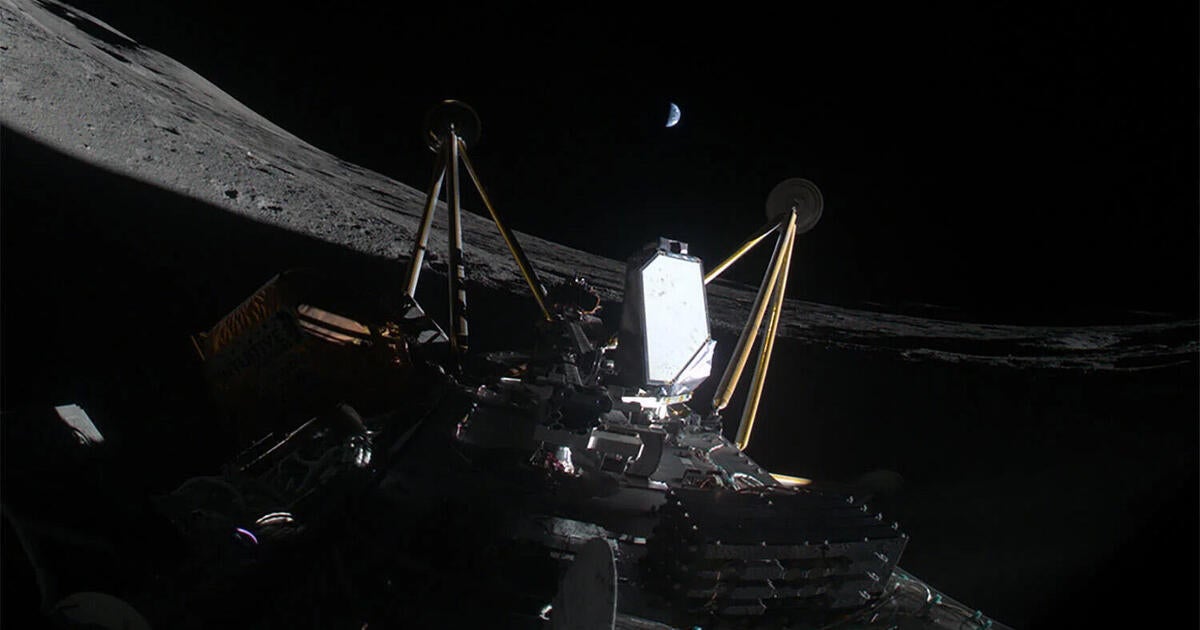
A dramatic photograph from Intuitive Machines’ Athena moon lander shows it touched down Thursday in a crater near the lunar south pole and tipped over on its side. Given a low sun angle and the orientation of the lander’s solar cells, the spacecraft’s battery quickly drained, bringing the mission to an early end, company officials said Friday
“Images downlinked from Athena on the lunar surface confirmed that Athena was on her side,” the company said on its website.
Intuitive Machines
“After landing, mission controllers were able to accelerate several program and payload milestones, including NASA’s PRIME-1 (drill) suite, before the lander’s batteries depleted,” the statement continued. “With the direction of the sun, the orientation of the solar panels, and extreme cold temperatures in the crater, Intuitive Machines does not expect Athena to recharge. The mission has concluded and teams are continuing to assess the data collected throughout the mission.”
Launched Feb. 26 atop a SpaceX Falcon 9 rocket, the Athena lander carried 10 science instruments and technology demonstrations funded by a NASA program that pays commercial spacecraft operators to deliver the agency’s payloads to the moon. The goal is to collect data needed before astronauts return to the moon in the 2027-28 timeframe.
In this case, NASA agreed to pay Intuitive Machines $62.5 million to deliver a drill and a mass spectrometer, known as Prime-1, to the moon. NASA’s “tipping point” technology development program paid $15 million for Nokia cellular communications equipment and another $41 million to help finance an innovative rocket-powered “hopper” designed to jump into and out of a permanently shadowed crater in search of ice.
Athena performed flawlessly from launch to lunar orbit and most of the way to the lunar surface. But shortly before touchdown, the lander’s autonomous guidance and navigation system began steering to one side, presumably to avoid boulders or some other hazard on the surface, and ended up coming down in a crater some 820 feet from the intended target.
The spacecraft may have tipped over after hitting the ground at an angle or due to some residual sideways motion. Intuitive didn’t address the final seconds of the landing, but said that even resting on its side, Athena remained functional, acknowledging commands from the ground, downlinking data and attempting to recharge its batteries. But it was not enough.
“This southern pole region is lit by harsh sun angles and limited direct communication with the Earth,” Intuitive Machines said on its web page. “This area has been avoided due to its rugged terrain and Intuitive Machines believes the insights and achievements from IM-2 will open this region for further space exploration.”
The landing mishap was the second such disappointment for Intuitive Machines. The company’s first moon lander, named Odysseus, touched down on the moon last year, but it hit the surface harder than expected and a landing leg failed. The vehicle ended up on its side and unable to complete its mission.
Athena’s arrival was preceded by the successful touchdown of a commercial lander built by Austin, Texas-based Firefly Aerospace that also carried NASA-sponsored payloads to the surface. That spacecraft, known as Blue Ghost, landed Sunday in a different region of the moon with much more forgiving terrain.
A third privately-built lander, this one from Tokyo-based ispace, was launched atop the same Falcon 9 that boosted Blue Ghost into space. The Japanese Resilience lander is taking a longer, low-energy route to the moon and is expected to land in June.