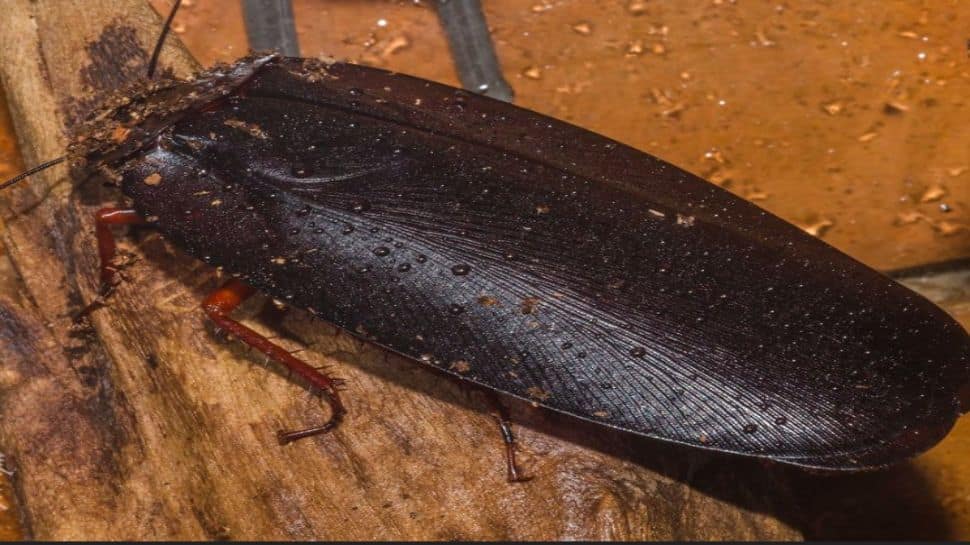
World’s Largest Cockroach: Megaloblatta longipennis, a true marvel of the tropical rainforests of South and Central America, holds the record as the world’s largest winged cockroach. Scientists have been captivated by this unique genus for more than a century, drawn to its extraordinary size, broad wings and impressive survival abilities.
Ongoing research continues to uncover fascinating insights into its behaviour, evolution and ecological role in the jungle ecosystem.
According to the Guinness World Records, Megaloblatta longipennis is native to the dense tropical forests of Peru, Ecuador and Panama. One preserved female specimen from Akira Yokokura’s collection in Yamagata, Japan, measures an astonishing 97 millimetres (3.8 inches) long and 45 millimetres (1.75 inches) wide, with wingspans that can reach up to 20 centimetres (8 inches).
Add Zee News as a Preferred Source
For comparison, most common cockroaches only measure between 0.6 and 7.6 centimetres (0.24-3 inches) in length, making Megaloblatta a true giant in its insect world.
Classified under the kingdom Animalia and phylum Arthropoda, Megaloblatta belongs to the class Insecta and order Blattodea, which encompasses all cockroaches. It falls under the superfamily Blaberoidea and family Ectobiidae, a name restored from Blattellidae following updated taxonomic research.
Members of Ectobiidae display flexible egg cases and, in some cases, feed on wood. Megaloblatta belongs to the subfamily Nyctiborinae, nocturnal insects that inhabit dense forests. The genus was first described in 1887 by German entomologist Heinrich Dohrn. Derived from Greek, the name Megaloblatta literally translates to “large cockroach”, a fitting label for these forest giants.
Dohrn’s initial studies focussed on specimens from Peru and Panama, highlighting their differences from similar cockroach groups. Early research was complicated by misidentifications with the Blabera genus, but over time, additional collections allowed scientists to refine their understanding.
American entomologist Morgan Hebard contributed significantly in 1920 by detailing the appearance and distribution of several species in Panama.
Fieldwork throughout the Amazon and Central America has expanded scientific knowledge, and by the 1980s, researchers had uncovered behavioural insights. A 1982 study revealed that nymphs of Megaloblatta blaberoides produce a loud sound by rubbing parts of their abdomen, a defensive mechanism against predators. This sound-producing ability also became a useful trait for distinguishing between species.
Megaloblatta cockroaches are easily recognisable by their elongated and flattened bodies, which allow them to move through narrow spaces like bark crevices, soil layers and leaf litter. A large pronotum shields the head when threatened, while strong, spiny legs enable rapid movement across the forest floor or up tree trunks.
They have two pairs of wings. The rigid top pair protects the body, while the thinner bottom pair allows for gliding and short flights. Adults typically display reddish-brown to dark-brown colouring, long antennae for sensing their environment and large compound eyes for excellent low-light vision. Some species have special abdominal structures to produce defensive sounds.
Megaloblatta is the largest cockroach genus globally, with adult body lengths ranging from 4 to over 9 centimetres. The record-holder, a female Megaloblatta longipennis, measures 9.7 centimetres long and 4.5 centimetres wide, with wingspans of up to 20 centimetres.
Sexual dimorphism is clear with males generally having longer wings for better gliding and often staying higher in the forest canopy, while females are wider with larger abdomens to carry egg cases. Size can vary based on habitat, with individuals from wetter and nutrient-rich forests like the Amazon often growing larger.
While some species, such as Megaloblatta insignis, remain relatively small at around 4 centimetres, Megaloblatta longipennis stands out as a true rainforest giant.
Megaloblatta longipennis is not only an insect but also a proof of the incredible diversity and resilience of rainforest life. Its size, strength and adaptability make it one of the most fascinating creatures in the jungle, a giant that has thrived for centuries under the dense canopy of Central and South American forests.